- English
- French
- German
- Portuguese
- Spanish
- Russian
- Japanese
- Korean
- Arabic
- Irish
- Greek
- Turkish
- Italian
- Danish
- Romanian
- Indonesian
- Czech
- Afrikaans
- Swedish
- Polish
- Basque
- Catalan
- Esperanto
- Hindi
- Lao
- Albanian
- Amharic
- Armenian
- Azerbaijani
- Belarusian
- Bengali
- Bosnian
- Bulgarian
- Cebuano
- Chichewa
- Corsican
- Croatian
- Dutch
- Estonian
- Filipino
- Finnish
- Frisian
- Galician
- Georgian
- Gujarati
- Haitian
- Hausa
- Hawaiian
- Hebrew
- Hmong
- Hungarian
- Icelandic
- Igbo
- Javanese
- Kannada
- Kazakh
- Khmer
- Kurdish
- Kyrgyz
- Latin
- Latvian
- Lithuanian
- Luxembou..
- Macedonian
- Malagasy
- Malay
- Malayalam
- Maltese
- Maori
- Marathi
- Mongolian
- Burmese
- Nepali
- Norwegian
- Pashto
- Persian
- Punjabi
- Serbian
- Sesotho
- Sinhala
- Slovak
- Slovenian
- Somali
- Samoan
- Scots Gaelic
- Shona
- Sindhi
- Sundanese
- Swahili
- Tajik
- Tamil
- Telugu
- Thai
- Ukrainian
- Urdu
- Uzbek
- Vietnamese
- Welsh
- Xhosa
- Yiddish
- Yoruba
- Zulu
Durable and Elegant Glass Spirit Bottles for Premium Liquor Packaging
For distilleries and spirit makers looking to protect the quality of their products and improve brand image, glass spirit bottles are a crucial investment. These cases are made from high-quality soda-lime-silica glass. They keep the complex aromas and flavors of whiskey, gin, rum, and vodka by having chemically neutral surfaces that don't react with ethanol. In addition to keeping their functionality, they have the clear appearance and heavy "hand-feel" that people connect with high-quality products. Choosing the right glass spirit package option has a direct effect on market positioning and long-term brand loyalty among picky buyers in competitive retail settings, where packaging affects buying decisions within seconds.
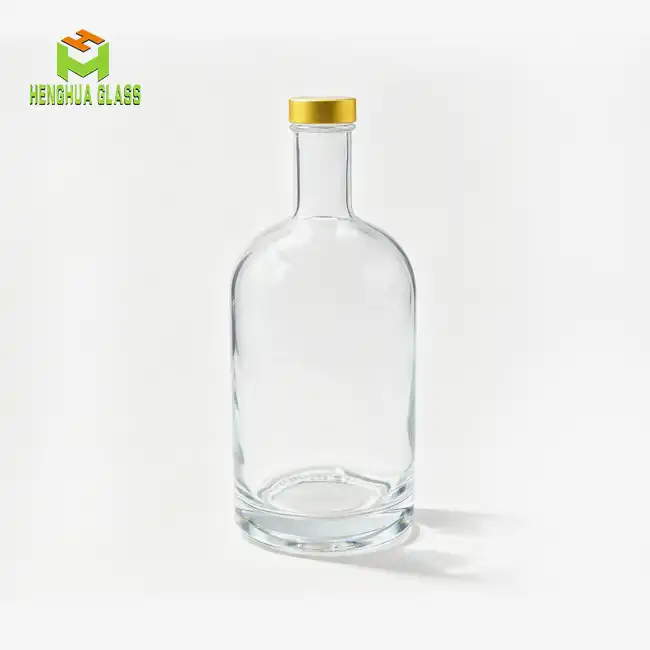
Understanding Glass Spirit Bottles: Types, Benefits, and Uses
Common Bottle Types and Standard Capacities
The liquor business uses a number of basic bottle shapes that are made to work with various types of products and delivery methods. Round bottles are the most popular because they are structurally stable and can be used with high-speed automatic filling lines. Standard sizes include 500 ml, 750 ml, and 1000 ml, and brands can also customize amounts from 16 oz to 32 oz to meet the needs of a wide range of customers and local market rules. Amber-colored versions are used for drinks that need UV protection, while clear and blue glass versions show off the clarity of expensive vodka and gin.
Durability Advantages Over Alternative Materials
The thicker bottle body design makes it very resistant to impact throughout delivery networks, which lowers the number of broken bottles that happen with thinner packing options. The smooth inside wall surface keeps flavors from getting messed up, which is a common problem with plastic containers that can let chemicals leak into high-proof liquids over time. Glass spirit bottles keep their shape even when the temperature changes, so they work reliably whether they're kept in climate-controlled stores or in people's freezers. This temperature resistance keeps the material from cracking and warping in cold places, which can happen with other materials.
Applications Across Market Segments
Heavyweight base designs and extra flint glass are used by premium whiskey makers to give old spirits more visual depth and give the bottles the shelf presence that supports their high prices. Craft breweries make their own brand names stand out in busy markets by changing the shapes and finishes of their bottles, such as engraving the inside, screen printing, and artistic firing. In addition to being used for business bottling, these cases are also used for gifting and limited-edition releases, where the wrapping is an important part of the collectible value.
How to Choose Durable and Elegant Glass Spirit Bottles for Your Brand
Defining Your Packaging Requirements
To choose the right bottle, you must first know what kind of spirit you're looking for and how it should be stored. Amber glass protects dark drinks from dangerous UV rays, which extends their shelf life without changing the taste. For liquid clarity as a quality cue, white drinks need super flint glass that is very pure optically. Think about the type of person you want to buy your product. People who are more interested in luxury items will respond to heavier bottles and more complicated surface treatments. On the other hand, people who are more interested in saving money will value functionality over style.
Critical Selection Metrics for Procurement Teams
Glass Thickness and Structural Integrity: The way wall thickness is distributed has a direct effect on how resistant it is to breaking during shipping. Make sure that the providers test the material with multiple ultrasonic waves to find any weak places that could break under mechanical stress. Ask for proof of the results of thermal shock testing, which involves putting samples through 42°C temperature differences to mimic the washing and filling stresses that happen in real life.
Closure Compatibility: Screw cap finishes need very close limits on sizes to make sure they fit tightly and don't leak. Check that the neck finish specs are in line with GPI standards to make sure they will work with your current capping tools. Closures made of wood, metal, or plastic all look and work differently. Metal caps with gold or silver finishes make items seem more valuable, while wooden closures are popular in craft markets that value hand-made goods.
Customization Impact on Supply Chain: Changes to the shape of Glass Spirit Bottles have an effect on how efficiently they are packed on pallets and how much it costs to ship each unit. When compared to standard formats, unique shapes may need special protective packing that raises landing costs by 15 to 30 percent. Find the right balance between the benefits of difference and the difficulties of logistics by checking to see if customizing the surface through screen printing, hot stamping, or label application meets brand goals without changing the size of the item.
Professionals in charge of buying things should give priority to sellers whose production capacity matches the yearly number needs. Manufacturers who run 150-ton glass melting kilns and make more than 1 million units a day have the scalability needed for long-term partnerships and keep enough inventory on hand to ship standard SKUs right away.
Comparing Glass Spirit Bottles with Alternative Packaging Solutions
Material Performance Analysis
Glass is chemically neutral compared to plastics, so it doesn't change the taste of food like ethanol does when it extracts plasticizers from polymer matrices over long holding periods. This ability to keep things fresh becomes very important for old drinks, where the quality is determined by the presence of small aromatic molecules. When it comes to environmental sustainability, glass spirit bottles are becoming more popular because they can be recycled over and over again without losing their quality. This is in contrast to plastic, which can only be recycled a fixed number of times and causes ongoing worries about microplastic pollution.
Closure System Evaluation
Screw caps offer solid hermetic closing that works well in high-speed production settings. Roll-on pilfer-proof designs that customers can see as proof of tampering are also available. They can hold sealing devices made of glass balls, steel balls, or plastic balls, based on the leak resistance requirements. For the screw cap to work properly, it needs to be manufactured with great accuracy. This means that strict dimensional control is needed when bottles are being made, because verticality errors that are too big cause sealing failures and line downtime during automatic capping operations.
Luxury Positioning Through Material Choice
Premium glass bottles show quality in ways that plastic packages can't: they feel and look better. The cold, smooth surface and heavy weight give people sensory experiences they link with sincerity and quality. This difference in how people see things directly affects how much people are willing to pay for the same drinks in glass versus plastic packing, which commands price premiums of 20–40% across multiple market studies.
The Manufacturing and Quality Assurance of Durable Glass Spirit Bottles
Production Process and Quality Control
Modern glass bottle making starts with carefully controlling the formulation of the raw materials. Silica sand, soda ash, and limestone are mixed to specific standards that decide the final strength and optical qualities. Glass is melted in kilns that reach 1500°C. The liquid glass is then shaped into precise bottle shapes by automated processes. Then, annealing ovens slowly cool the bottles to ease the forces inside them. If the annealing isn't done right, the bottles will break on their own weeks or months after they were made.
Certifications and Compliance Standards
Leading makers keep their CE, FDA, SGS, and LFGB certifications up to date to show that they follow safety rules in all of their major export markets. For these certifications, production sites, methods for managing quality, and where raw materials come from must be regularly inspected by a third party. When a seller is being qualified, business-to-business buyers should ask for up-to-date certifications and test results that confirm chemical protection and structural performance standards for glass spirit bottles.
Sustainability Practices in Modern Production
Today's advanced makers use closed-loop recycling systems where cullet (recycled glass) makes up to 90% of the raw materials. This uses a lot less energy than making new glass. This circular economy method fits with the environmental goals that big spirits brands are starting to make more and more popular. Improvements to production effectiveness, such as heat return systems and better furnace operation, help lower the company's environmental impact even more while keeping costs low.
Procurement Strategies for Bulk Purchasing of Glass Spirit Bottles
Supplier Vetting and Selection Criteria
Look for possible partners whose production capacity has been shown to be scalable. Suppliers with multiple furnace lines and automatic production systems can handle changes in volume without affecting delivery times. Manufacturing experience of 20 years or more means that process rules and worker knowledge are well-established, which is important for maintaining quality. Ask for examples from current customers in similar market groups to make sure you can be relied on during busy times.
Customization Services and Brand Differentiation
Strategic use of customization options improves standing in the market without adding too many costs. Surface treatments like gold stamping, bronzing, and thermal transfer printing give Glass Spirit Bottles better looks for less money per unit than structural changes. Brand protection that can't be copied is achieved through internal etching, which creates complex visual effects that can't be copied through external decoration. Customizing the packaging box completes the display. This is especially important for gift markets and limited-edition releases, where the experience of opening the box affects how people think of the brand.
Logistics Optimization and Cost Management
International shipping costs are big parts of landing costs, so where the seller is located and how much experience they have with exporting are important things to look at. Manufacturers who already have transportation partners in place can handle customs paperwork and combining freight more easily than sellers who haven't done it before. Ask about transportation loss compensation policies that protect buyers from breaking items while in transit. Reliable providers will cover the cost of repair for damage rates that go above and beyond agreed-upon limits.
Minimum order numbers depend on how complicated the customization is. For example, standard bottles are usually only available in smaller quantities than fully customized designs that need special production runs. Ask your providers to keep safety stock of your specific SKUs as part of inventory management deals. This will allow just-in-time replenishment, which cuts down on the need for storage space while ensuring supply continuity.
Conclusion
When choosing the right glass spirit bottles, you have to find a balance between how they look, how well they work, and how much they cost. Because the material is chemically inert, structurally durable, and gives the impression of a high-end brand, it is essential for competitive standing in the drinks market. Successful purchasing plans focus on building relationships with suppliers that can provide constant quality, the freedom to make changes, and the ability to increase production capacity as needed for long-term business growth. Brands find package solutions that protect the integrity of their products while also making them stand out on shelves and appeal to customers by carefully evaluating their manufacturing capabilities, quality assurance processes, and logistical dependability.
FAQ
What maintenance protocols ensure glass spirit bottle longevity?
Glass spirit bottles don't need much care besides being cleaned regularly. Rinsing with warm water and letting it dry in the air stops grime from building up on reused items. To keep bottles from getting heat shock, change the temperature slowly instead of all at once. Keeping things in climate-controlled spaces protects the integrity of the closing and stops condensation that could make it harder for labels to stick.
What are typical minimum order quantities for custom glass bottles?
Standard bottle designs usually need at least 10,000 to 50,000 units to be ordered, while fully customized forms and molds usually need 100,000 or more units to be ordered in order to justify the cost of the tools. Screen printing and marking are two surface customization choices that usually have lower minimums of between 5,000 and 20,000 units. Talk to sellers about volume flexibility during the first talks so that the size of your orders matches your market testing and growth predictions.
How do eco-friendly glass options impact procurement costs?
Because they use less energy and raw materials, bottles made with a lot of recovered content (cullet) usually cost 5 to 10 percent less than bottles made from pure glass. This lower cost makes recyclable glass appealing from a business point of view as well as an environmental one. Lightweight bottle designs save money on shipping costs without sacrificing structural integrity, but they may need more secure packing while being shipped.
Partner with Henghua for Your Premium Glass Spirit Bottle Needs
We encourage sourcing managers and brand owners to look at Henghua's full line of glass spirit bottles, which are made to hold high-end liquor. With more than 20 years of experience making things and 10 sets of 150-ton glass melting furnaces, we can make up to 1 million units per furnace every day, so you can be sure of a steady supply for your large needs. Our certificates from CE, FDA, SGS, and LFGB make sure that our products are legal in all global markets. We also offer full ODM/OEM services, which let you choose from different bottle sizes, colors, closures, and surface treatments. As a seller of bottles with a lot of experience, we can offer you cheap factory-direct prices, free samples, and compensation for transportation loss so that you can work with us without any worries. Get in touch with denny@henghuaglass.com right away to talk about your unique needs and ask for samples that show how committed we are to quality.
References
1. International Journal of Packaging Technology and Science, "Chemical Interaction Between Ethanol-Based Beverages and Container Materials: A Comparative Study," 2021.
2. Spirits Packaging Association, "Industry Standards for Glass Bottle Performance in High-Proof Applications," 2020.
3. Journal of Food Packaging and Shelf Life, "Impact of Container Material on Flavor Preservation in Distilled Spirits During Long-Term Storage," 2019.
4. Glass Manufacturing Industry Council, "Quality Control Protocols and Testing Standards for Beverage Container Production," 2022.
5. Sustainable Packaging Coalition, "Life Cycle Assessment of Glass Versus Alternative Materials in Premium Beverage Markets," 2023.
6. International Organization for Standardization, "ISO 8106: Glass Containers – Capacity and Volumetric Measurement Methods," 2018.
Learn about our latest products and discounts through SMS or email