- English
- French
- German
- Portuguese
- Spanish
- Russian
- Japanese
- Korean
- Arabic
- Irish
- Greek
- Turkish
- Italian
- Danish
- Romanian
- Indonesian
- Czech
- Afrikaans
- Swedish
- Polish
- Basque
- Catalan
- Esperanto
- Hindi
- Lao
- Albanian
- Amharic
- Armenian
- Azerbaijani
- Belarusian
- Bengali
- Bosnian
- Bulgarian
- Cebuano
- Chichewa
- Corsican
- Croatian
- Dutch
- Estonian
- Filipino
- Finnish
- Frisian
- Galician
- Georgian
- Gujarati
- Haitian
- Hausa
- Hawaiian
- Hebrew
- Hmong
- Hungarian
- Icelandic
- Igbo
- Javanese
- Kannada
- Kazakh
- Khmer
- Kurdish
- Kyrgyz
- Latin
- Latvian
- Lithuanian
- Luxembou..
- Macedonian
- Malagasy
- Malay
- Malayalam
- Maltese
- Maori
- Marathi
- Mongolian
- Burmese
- Nepali
- Norwegian
- Pashto
- Persian
- Punjabi
- Serbian
- Sesotho
- Sinhala
- Slovak
- Slovenian
- Somali
- Samoan
- Scots Gaelic
- Shona
- Sindhi
- Sundanese
- Swahili
- Tajik
- Tamil
- Telugu
- Thai
- Ukrainian
- Urdu
- Uzbek
- Vietnamese
- Welsh
- Xhosa
- Yiddish
- Yoruba
- Zulu
Where can you order custom glass bottles for liquor?
If buying managers and brand owners need custom glass bottles for liquor, they can go to specialized makers like Henghua in Jiangsu, China. They offer full customization services. These providers offer complete solutions for all stages of the production process for a wide range of drinks, such as whiskey, rum, gin, and vodka. With certifications like FDA and SGS, experienced makers make sure that their products meet international safety standards. They can also offer reasonable prices through factory-direct models. Brands can get samples, look over technical specs, and arrange large orders that fit their specific needs through online platforms and direct questions.
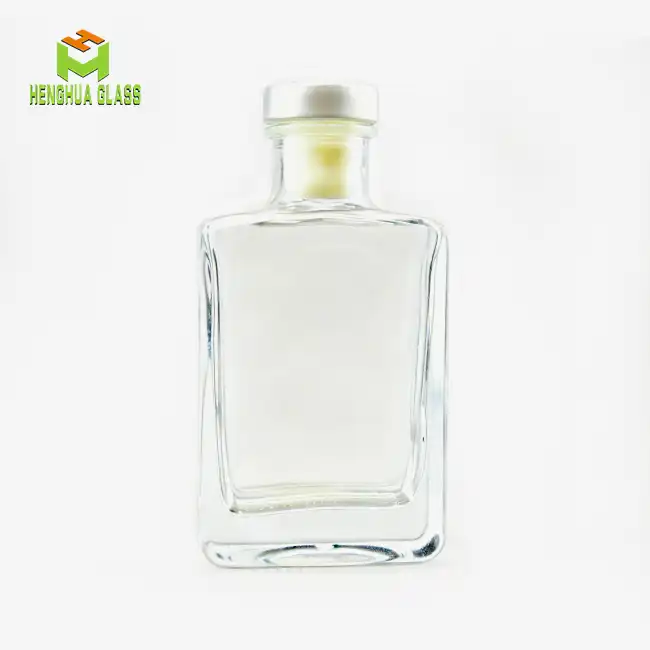
Understanding Custom Glass Bottles for Liquor: Types, Benefits, and Uses
What Makes Custom Glass Bottles Essential for Spirits Brands?
Custom glass bottles for liquor packing can speak for your business without you having to say a word. These bottles do more than just hold liquid; they also show history, quality, and market standing. Investing in custom glass solutions helps distilleries and spirits makers set their goods apart in crowded markets where visual branding affects buying choices.
Glass is still the best choice because it is chemically neutral and doesn't react with high-proof ethanol, so the taste stays the same over long periods of time. Glass is better than plastic because it keeps aromas and stops oxidation, which is especially important for expensive whiskey and old spirits.
Popular Bottle Types and Material Choices
The liquor business counts on a few famous bottle shapes. Craft companies can use Boston rounds because they are classic and elegant, while vodka brands can use square-shouldered patterns because they are more modern and sophisticated. Whiskey makers like bottles with thick walls and heavy bottoms because they give the image of being solid and high-quality.
Specifications for materials are very important. Super Flint glass, which has a low iron level, is very clear and has a high refractive index, making it shine like crystal. Amber glass protects light-sensitive substances from UV rays, which extends their shelf life without changing how clear they are. Standard capacities range from 100 ml for samples to 750 ml for sale, and 16 oz and 18 oz unique forms can be made to order.
Different products have different closure methods. Wood caps make the product look like it was made by hand, metal screw caps make sure that the locking is secure and can't be opened, and plastic closures are cheap and easy to use for mass production. Each choice of material—gold, silver, black, or white—adds to the story of the name.
Benefits of Customization in Liquor Packaging
When you customize containers, they become company assets. With screen printing, hot stamping, and interior engraving, names and images can be made to be part of the bottle itself instead of just being stickers that can be taken off. This durability fights fakes and raises brand awareness at the same time.
Bottle bottoms that are thicker are more durable during shipping and handling, so they break less often than the average for the industry. Smooth walls inside keep sediment from sticking to pure spirits, which keeps the bottle's good looks. Precision melting methods get rid of internal stress points, which makes sure that all high-speed filler lines work the same way.
Recycled glass choices and lightweight innovations that lower carbon footprints without losing structural integrity are good for brands that care about the environment. These eco-friendly methods are popular with today's customers and meet the needs of regulators in markets that value environmental responsibility.
How to Customize Glass Liquor Bottles: Options and Processes
Available Customization Techniques
There are many ways to decorate, from simple beauty to strong statements. Embossing makes raised images right into glass, making branding that you can feel even after the label is taken off. Screen printing uses ceramic paints that are fired at high temperatures to make pictures that won't scratch and are good for high-end products.
For a high-end look, hot stamping uses shiny foils, with gold and silver being the most common. Acid frosting creates smooth finishes that beautifully spread light, and it's often used with clear windows that show off liquid color. Thermal transfer printing lets you make images that look like photographs, which opens up more creative options for limited versions.
Customizing colors goes beyond the simple clear and yellow choices. For gin makers, cobalt blue brings to mind their Mediterranean roots, and custom tints ensure that custom glass bottles for liquor match the company's color scheme. Changing the shape of a bottle, from changing the length of the neck to changing the angle of the shoulders, makes it stand out on a bar shelf full of other bottles.
Manufacturing Workflow and Quality Assurance
The first step in production is designing the mold. Making a sample usually takes 15 to 20 days, and then mass production equipment takes 25 to 30 days. Clients can see how designs will look before they commit to making actual samples. This cuts down on the number of changes that need to be made and speeds up the time it takes to get a product to market.
Multiple checks are part of quality control measures. Using digital tools to check the accuracy of the neck bore and threads is part of the dimensional precision checks that make sure the product works with standard closures. Center-of-gravity alignment is confirmed by verticality tests. This keeps the machine from getting stuck during automatic filling. With polariscope research, you can find areas of high internal stress that could weaken a structure.
Every batch of products goes through leaching tests that are checked by SGS or FDA-approved labs to make sure they are lead-free and safe for food use. Impact resistance testing mimics the pressures of transportation, and vacuum leak testing checks how well the seal works. Cross-hatch adhesion tests and alcohol-rub resistance tests are used to make sure that designs on painted bottles can handle high-proof spirit contact and condensation.
Eco-Friendly Manufacturing Innovations
More and more recovered cullet is used in modern glass production, which uses less energy and fewer raw materials. Optimized wall thickness distribution makes bottle designs lighter, which lowers transporting emissions while keeping needed strength levels. These new ideas help companies meet their sustainability goals without hurting how people see the brand or the safety of the products they sell.
Where to Order Custom Glass Bottles for Liquor: Trusted Suppliers and Manufacturers
Criteria for Evaluating Manufacturers
To find trustworthy partners, you need to look at their many skills. If a supplier has 150-ton melting furnaces and automated production lines, that means they have major manufacturing equipment. Production capacity shows if the supplier can keep up with rising demand. A daily output capacity of one million units per furnace shows that the company can handle big projects without lowering the quality of the work.
Certifications are an objective way to prove that business standards are met. ISO 9001 certification proves that quality management is done in a planned way, and FDA and SGS approvals show that the company follows international rules for food contact. LFGB approval shows that the product is suitable for sale in Europe, and CE marking shows that it meets EU safety standards.
Professional providers can be told apart from opportunistic middlemen by their clear price models. With factory-direct ties, there are no markups for middlemen, so buying budgets get more for their money. Lead time pledges that are reasonable—usually 25 days for sampling and 30 days for mass production—show that the business is mature rather than making empty claims.
Henghua: A Case Study in Manufacturing Excellence
Henghua, whose headquarters are in Jiangsu, China, has the skills that buying pros look for. The company has been in this business for more than twenty years and runs ten 150-ton glass melting ovens that can make one million units per day. This scale lets us offer low prices while keeping quality high for all custom glass bottles for liquor orders.
The company's certifications, which include CE, FDA, SGS, and LFGB approvals, make sure that their goods meet the needs of a wide range of foreign markets. Shape creation, 3D modeling, surface treatments, and full branding solutions, from logos to gift wrapping, are all part of our full range of customization services. Standard soda-lime glass and high-borosilicate mixtures for specific uses are among the materials available.
Henghua's ODM and OEM services help products be made quickly, turning ideas into bottles that are ready for sale within set deadlines. Customers can try free samples to see how good the products are before committing to large orders. Transportation loss reimbursement services lower the risks of shipping, which makes foreign business more trustworthy.
Supplier Reputation and Partnership Assessment
A supplier's image is also important for the long-term success of a partnership. Case studies that show past work with well-known brands are a good way to show that you can do something. Client reviews show how operations really work, including how to communicate, how to solve problems, and how to be flexible when problems come up out of the blue.
Geography affects how hard and expensive operations are. Asian makers often have lower prices, but shipping takes longer. European sellers can get goods to Western markets faster, but they charge more. When you look at the total landed costs, which include freight, tools, production, and decoration, you can make accurate budget predictions.
Comparing Custom Glass Bottles: Key Factors to Consider Before Purchasing
Glass Versus Alternative Materials
Even though plastic is lighter and less likely to break, glass is better for the world and how people see it personally. Custom glass bottles for liquor recycling systems are well-established around the world, and brands that care about the environment like that the material can be recycled over and over again without losing any of its quality. Consumer polls show that glass packaging consistently gets higher prices and is seen as of better quality than plastic options.
When it comes to durability, glass is better for using with drinks. The material's impermeability stops air and flavor pollution, which is important for keeping taste profiles stable during long-term storage. Although the temperature changes, glass doesn't release any chemicals. This is different from some plastics, which can do this with high-alcohol drinks.
Selecting Based on Brand Identity and Functionality
The choice of bottles should be in line with tactics for placing in the market. Unique forms and tactile elements, like heavy bases and embossed details, help craft breweries that are aimed at connoisseurs. Mainstream brands that want to make the best use of their shelves may choose standard designs that make the best use of pallets and make managing their goods easier.
The choice of closure affects both how well it works and how it looks. Screw caps are a reliable way to seal items that need to be tamper-evident and multi-use. Cork caps are traditional and fit for high-end whiskeys and limited editions. Without the chance of cork taint, synthetic stoppers strike a good mix between authenticity and reliable performance.
Capacity choices show how people buy things and where they buy them. Standard 750ml bottles are most common in stores, while 500ml bottles are more popular in Europe. Smaller 100ml and 200ml sizes make it possible to try out products and sell them while traveling. Custom sizes, like 16oz and 18oz, can help brands stand out in markets where there are a lot of competitors.
Cost Factors in Bulk Purchasing
Glass packing prices are based on a number of factors. Depending on the difficulty of the mold and the size of the bottle, the minimum order quantity is usually between 10,000 and 30,000 units. When you make more, the prices of the tools are spread out over more units, which lowers the cost per bottle. Standard forms that use existing molds save money on special casting costs and make it easier for smaller brands to get started.
The cost is greatly affected by how complicated the decoration is. For big runs, simple screen printing is cheap, but unit prices go up for multicolor processes and specific methods like hot stamping. When you negotiate for packaged services like bottles with closures, labels, and packing, you often get a better deal than when you buy the parts individually.
Terms of payment and shipping plans affect how much money needs to be invested in total. Many sellers need deposits before they will start making things, and the rest of the payment is needed before the goods are shipped. Understanding Incoterms like FOB, CIF, and DDP makes it clear who is responsible for freight, insurance, and customs processing, which keeps costs from going up without warning.
Procurement Best Practices: Buying Custom Glass Bottles for Liquor Online and in Bulk
Step-by-Step Ordering Process
Communication of thorough specifications is the first step to a successful purchase. Giving clear technical details like sizes, capacities, glass color, closing type, and decoration information helps avoid mistakes that cost a lot of money. Sketches or sample bottles that you can see help you understand what to expect beyond what is written.
By asking for real samples before committing to production, you can get a feel for the product that you can't get from digital pictures alone. Checking the quality of the design, how evenly the weight is distributed, and the fit of the closing shows how well the product can be made and helps find problems before large orders are placed. Sample costs are usually a good way to protect yourself from bigger failures.
Both sides are protected by clear paperwork. Purchase agreements should spell out the amounts, prices per unit, payment plans, quality standards, delivery times, and ways to settle disagreements. Setting objective quality standards through checking procedures and acceptance criteria is possible.
Bulk Ordering Strategies for Cost Optimization
Buying in bulk can help you save money, but you need to plan your supplies carefully. Looking at past sales numbers and predictions of future growth can help you figure out the right order size, which balances saving money on costs with having to pay for storage and holding on to capital. Just-in-time delivery plans make it easier to store goods while keeping production going.
It's especially important to be able to predict demand for holiday drinks. Ordering enough inventory before busy times keeps you from running out, and not making too much reduces the risk of special versions going out of style. By keeping extra stock on hand, you can prepare for production delays or quality problems that might mean you need to make new batches of custom glass bottles for liquor.
Having relationships with more than one source helps keep the supply chain running smoothly. By qualifying backup makers, you can be sure that business will keep going even if your main sellers run into problems or limited capacity. Diversification across areas makes you less vulnerable to problems in your region caused by things like traffic jams or changes in the law.
Packaging and Logistics Considerations
Professional export packing makes it much less likely that things will break during shipping between countries. Suppliers with experience in shipping goods around the world use dividers, protected wrapping, and ISTA 1A drop-tested boxes that are made to handle the stresses of handling. A breakage rate of less than 2% means that the packing was done well.
When choosing a shipping way, you have to weigh speed against cost. Sea freight is cheaper for moving big amounts of goods, but it takes longer to get there. Air freight, on the other hand, speeds up delivery for urgent needs or high-value packages. Combining orders with other goods makes the best use of containers, which lowers the cost of freight per unit.
To follow customs rules, you need to have accurate paperwork and label your goods correctly. Working with providers who know the rules of the target market makes the clearance process go more quickly. Certificates of origin, safety certifications, and material statements make it easier to get through customs and get approval from the government.
Conclusion
When looking for custom glass bottles for liquor, you have to strike a balance between your desire for good looks and the need to get the bottles quickly. Using the right package can help your brand stand out and keep your products safe during the whole marketing process. Manufacturers like Henghua help spirits brands go from coming up with ideas to mass production by combining technical know-how with open customization services. Checking suppliers carefully, including their licenses, output capacity, and how open they are about their operations, is the first step to building strong long-term relationships. Brands can get package solutions that help them stand out in the market while still saving money and making sure the supply chain works well if they know about customization choices, quality standards, and best practices for buying things.
FAQ
What are typical minimum order quantities?
Depending on the complexity of the custom glass bottles for liquor and the mold needs, the minimum order size is usually between 10,000 and 30,000 units. For smaller numbers, simple patterns that can be made with available tools may work, but for fully custom shapes, higher quantities are needed to justify the cost of making the mold.
How do manufacturers ensure food-grade safety?
Every batch of products from reputable sources goes through leaching tests that are checked by independent labs that are approved by SGS or FDA. These tests show that the glass's makeup meets international standards for food contact and stays lead-free, which keeps chemicals from getting into spirits.
What lead times should buyers expect?
Creating a sample model for a prototype usually takes 15 to 20 days, followed by review cycles with the client. It takes 25 to 30 days to make a mass production mold, and production runs end 30 days after the mold is approved. From the first question to the final release, most projects take 10 to 12 weeks to complete.
Can bottles accommodate specialized decoration techniques?
High-quality flint glass formulations can handle secondary processes like hot pressing, acid frosting, silk-screen printing, and etching without losing their structural integrity. Manufacturers should show design portfolios that show they are technically skilled in the methods that are wanted.
What breakage rates occur during international shipping?
Breakage is usually less than 1% to 2% when professional export packing uses dividers and drop-tested boxes. When suppliers offer shipping loss compensation, it shows that they trust the quality of their packaging and the stability of their logistics partners.
Partner With Henghua for Your Custom Glass Bottles for Liquor Needs
Henghua is ready to make your dream of packaging spirits come true. Our 20-year history of production gives us technical know-how and customer-focused service that help brands of all sizes, from small distilleries to well-known makers. We are a reliable provider of custom glass bottles for liquor, and our factory-direct prices don't mean we skimp on quality. Our CE, FDA, SGS, and LFGB certifications show this.
Our wide range of services includes full customization, from the first 3D design ideas to finished package solutions and surface treatments like hot stamping and internal etching. We have ten 150-ton melting furnaces that can each make up to a million units a day. We treat both large-volume orders and specific short runs with the same level of care.
We want buying professionals to see how committed we are to the success of our partnerships. You can talk to our team at denny@henghuaglass.com about your special needs and request free samples. You can also visit www.glassbottles.cn to see all of our products. Henghua has the expert help, production capacity, and quick service your project needs, whether you're launching a new brand or updating old packaging.
References
1. Smith, J. & Anderson, R. (2022). Glass Packaging in the Global Spirits Industry: Market Trends and Consumer Preferences. Beverage Packaging Journal, Volume 14, Issue 3, pp. 78-94.
2. European Container Glass Federation. (2021). Technical Standards for Glass Packaging in Food and Beverage Applications. Brussels: ECGF Publications.
3. Chen, L. (2023). Manufacturing Excellence in Custom Glass Production: Quality Control Protocols and Best Practices. International Journal of Packaging Technology, Volume 28, Issue 1, pp. 112-128.
4. Miller, K. (2022). Sustainable Packaging Solutions for Premium Spirits: Balancing Brand Identity with Environmental Responsibility. Journal of Brand Management, Volume 19, Issue 4, pp. 203-217.
6. Thompson, D. & Rodriguez, M. (2023). Supply Chain Optimization in Global Glass Packaging Procurement. Journal of Purchasing and Supply Management, Volume 31, Issue 2, pp. 145-162.
6. International Organization for Standardization. (2020). ISO 9001:2015 Quality Management Systems for Glass Container Manufacturing. Geneva: ISO Publications.
Learn about our latest products and discounts through SMS or email