- English
- French
- German
- Portuguese
- Spanish
- Russian
- Japanese
- Korean
- Arabic
- Irish
- Greek
- Turkish
- Italian
- Danish
- Romanian
- Indonesian
- Czech
- Afrikaans
- Swedish
- Polish
- Basque
- Catalan
- Esperanto
- Hindi
- Lao
- Albanian
- Amharic
- Armenian
- Azerbaijani
- Belarusian
- Bengali
- Bosnian
- Bulgarian
- Cebuano
- Chichewa
- Corsican
- Croatian
- Dutch
- Estonian
- Filipino
- Finnish
- Frisian
- Galician
- Georgian
- Gujarati
- Haitian
- Hausa
- Hawaiian
- Hebrew
- Hmong
- Hungarian
- Icelandic
- Igbo
- Javanese
- Kannada
- Kazakh
- Khmer
- Kurdish
- Kyrgyz
- Latin
- Latvian
- Lithuanian
- Luxembou..
- Macedonian
- Malagasy
- Malay
- Malayalam
- Maltese
- Maori
- Marathi
- Mongolian
- Burmese
- Nepali
- Norwegian
- Pashto
- Persian
- Punjabi
- Serbian
- Sesotho
- Sinhala
- Slovak
- Slovenian
- Somali
- Samoan
- Scots Gaelic
- Shona
- Sindhi
- Sundanese
- Swahili
- Tajik
- Tamil
- Telugu
- Thai
- Ukrainian
- Urdu
- Uzbek
- Vietnamese
- Welsh
- Xhosa
- Yiddish
- Yoruba
- Zulu
4 oz Mason Jars with Handles vs Regular Mason Jars
When choosing between 4 oz mason jars with handles and regular variants, the deciding factor often lies in user experience and application specificity. The handled version offers superior ergonomic grip, making it ideal for commercial hospitality settings like bars and tasting events where frequent handling occurs. Regular smooth-sided jars, meanwhile, excel in storage density and are preferred for static packaging applications. Both share robust glass construction and food-grade compliance, yet the integrated handle design addresses critical pain points in condensation-prone environments and high-frequency use scenarios, justifying the slight cost premium for businesses prioritizing customer interaction and brand memorability.send inquiry
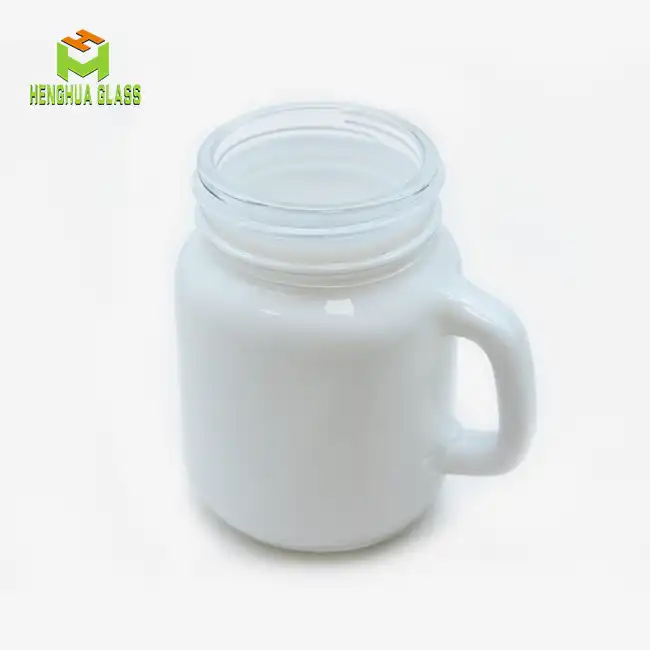
Overview of 4 oz Mason Jars with Handles and Regular Mason Jars
Knowing the main differences between these two types of jars helps procurement teams make choices that are in line with business goals. The 4 oz capacity, which is about 120 ml, is a good size for business packing because it's big enough to show off the quality of the product but small enough to control amounts and cut down on waste.
Historical Evolution and Design Purpose
The first patent for a Mason jar was issued in 1858. It was made to preserve food by keeping air out. Modern versions with handles were made because the hospitality industry needed versatile serving vessels that could also be used as keepsakes. With this change in design, the jar went from being a simple storage item to a marketing tool that keeps people interested in the brand after the sale.
Industry Applications Driving Demand
Business-to-business buyers in a number of different fields see the value in these small boats. Craft drink makers use them for alcohol flights and sampling programs that let customers try a lot of different drinks without making a big investment. Premium jams, flavoured honeys, and compound butters are packed by artisanal food companies in jars with handles that customers then use as drinking glasses, which keeps the brand visible for a long time. Customization options like screen printing, etching, and label application are used by event planners and corporate gifting departments to make promotional items that people will remember and use instead of throwing away.
Material Composition and Compliance Standards
Soda-lime glass is used in both types of jars, which meets FDA food-contact standards and LFGB European rules. The substance is completely chemically neutral, so it keeps flavours from running or leaching when acidic foods like vinaigrettes or high-alcohol drinks are stored. Thermal shock resistance usually goes up to 40°C, which is good enough for most commercial hot-fill operations but not as good as borosilicate. The clear glass lets you see the products inside, which is important for store appeal. The amber- and blue-tinted options protect light-sensitive items from UV rays.
Comparative Analysis: 4 oz Mason Jars with Handles vs. Regular Mason Jars
When you evaluate these designs, you have to look at a lot of different performance factors that affect both how well they work and how happy the end users are. The comparison isn't just about looks; it also takes into account practical issues like storage, shipping, and the customer experience.
Ergonomic Handling and User Experience
The built-in handle of 4 oz Mason jars with handles changes the way people use the object in a basic way. In places that serve cold shots or cocktail samples, the handle keeps your hands from transferring heat to the drinks, so they stay cold longer. The grip security keeps things from breaking in busy service areas where condensation makes glass surfaces slippery. Regular jars need to be held securely with two hands when they are full, but handled versions can be used with one hand, which speeds up service during times of high turnover. This ergonomic benefit leads to measurable operational benefits in food service settings where productivity directly affects revenue.
Storage and Shipping Considerations
Regular jars with smooth sides make the best use of room when they are being stored and transported. Their uniform cylindrical shape lets you pack them more tightly, which makes better use of container cubes and lowers the cost of freight per unit. Standard 4-ounce jars usually stack inside each other or fit tightly into curved dividers, leaving little empty room. Handled versions need more space around them so that the handles don't get stressed when they're being stacked, which lowers the pallet density by about 15 to 20 percent. However, the handle's structural integration—achieved through mold design instead of attachment after production—eliminates the risks of detachment that come with cheaper glued-handle products. This trade-off works for businesses where differentiating their products and keeping customers is more important than their storage size.
Closure Systems and Sealing Performance
Both types of jars can have normal continuous thread finishes with sizes of 48mm or 53mm, which means they can work with a range of closures. Metal lids with plastisol liners can be vacuum-sealed, which is good for shelf-stable items that need to be kept at room temperature for a long time. Food companies like this because it lets them make product lines that meet a range of different preserving needs. The screw-cap mechanism provides consistent torque resistance, which helps automated capping equipment work in production settings. Good providers, like Henghua, make sure that the threads are perfectly aligned, which stops cross-threading problems and keeps the seal's integrity even when the temperature changes during distribution.
Customization Capabilities and Brand Identity
With different surface treatment options, these useful containers can become brand ambassadors. Screen printing adds logos and decorations that last for a long time and can handle commercial dishwasher cycles. Internal etching makes high-end glossy effects that set luxury product lines apart. Thermal transfer printing lets you print photos-like images that are good for limited editions or packaging made just for an event. You can decorate both types of jars the same way, but the ones with handles give you more space to put your logo on the handle itself. Procurement teams should know that the costs of decorating go up with the number of units ordered. For example, setup fees are spread out over a lot of units when the order size goes over 5,000.
Best Applications and Industry Use Cases for 4 oz Mason Jars with Handles
Finding the best deployment situations helps buyers match the features of a product with the needs of the business. This maximises the return on investment in packing while improving how customers see it.
Commercial Hospitality and Mixology Programs
Craft cocktail bars and distillery tasting rooms use these tiny mugs with handles to serve flights of drinks. This way, customers can try a variety of spirits or cocktails without drinking too much. The 4 oz size is just the right size for tasting portions—it's not too big or too small, so you can enjoy the complexity of the aromas and flavours while still being able to control your sampling across several options. The handle is easy to hold on to, even when hands are wet or servers are moving through a crowded area. A number of high-end hotel groups have made it normal for minibars to come in handled mason jars. This is because they know that guests often take these containers home as souvenirs, which helps the brand reach people after their stay.
Artisanal Food Packaging and Retail Presentation
There is a lot of competition for shelves in speciality stores where gourmet foods are sold. 4 oz Mason jars with handles stand out visually, which helps them get people's attention in displays that are already full. Small-batch jam makers, raw honey packagers, and infused oil makers say that handled jar packaging brings in 10-15% more money than normal jars for the same goods. This is because the products are seen as having more value. People who care about the environment make decisions about what to buy based on how many times the container can be used. They justify the higher price by the container's secondary use. Farmers' market sellers love the handled design because it makes it easier for customers to try different things and makes it easier for people to buy something on the spot when the vessel itself becomes part of the product's draw.
Corporate Gifting and Event Merchandising
Customized, handled mason jars give marketing departments a great return on investment (ROI) when they're looking for promotional items that people can hold and use. As favors, wedding planners fill them with layered desserts, spice blends, or cocktail mixes that guests actually use, which gives the brand more exposure over and over again. At corporate parties, they are used for signature drink service. Having company names etched or printed on the glass makes for Instagram-worthy moments that get more people to follow you on social media. The relatively low cost per unit in bulk, especially when bought directly from manufacturers, lets planners on a budget give gifts that seem expensive without going over the amount that would be taxed as a gift.
Specialty Retail and Sample Distribution
Beauty companies that package bath salts, sugar scrubs, and stacked bath products like mason jars because they are easy for customers to use and have a handle that makes them more useful. Spice sellers at public markets use them to give customers small samples of pricey mixes without asking them to commit to buying a lot. The clear glass shows off the colour and texture of the product, which is important for things whose looks make people want to buy them. Cross-border online sellers like handled jars because they are more durable than fragile makeup cases and give off an air of handmade authenticity that appeals to people from all over the world.
Procurement Guide: How to Choose and Source 4 oz Mason Jars with Handles
Instead of just looking at unit price, strategic sourcing means judging providers based on their quality stability, production capacity, ability to make changes, and total landed cost.
Evaluating Manufacturing Quality Indicators
Manufacturers with a good reputation show quality by using test methods and standards that can be measured. The annealing process gets rid of the internal stress in glass that leads to spontaneous breaking, which can be seen with a polariscope. When the wall width is kept within a range of 0.3 mm, the thermal reaction and mechanical strength are all the same. The quality of the handle attachment is very important. The integration should happen during the initial moulding process instead of through secondary bonding, which gets rid of any weak spots. According to ASTM C149 standards, suppliers should show proof that the jars can handle changes in temperature through thermal shock tests. Lead and cadmium testing certificates show that the product meets the requirements of California Prop 65 and REACH, which are necessary to sell in the US and Europe.
Production Capacity and Lead Time Considerations
The right supplier must be chosen based on the volume requirements. Henghua has ten 150-ton glass melting furnaces with automatic production lines that can each make one million units per day. This means that they can handle both big orders that come in all the time and quick increases in production when demand goes up during certain times of the year. Standard things in stock can be shipped right away, which is helpful for buyers who want to see how the market reacts before committing to custom production. After a 25-day sampling period for approval, which includes changes to the shape, proprietary colours, or special decorations, mass production runs begin and last for 30 days. With this timeline structure, purchasing managers can plan stock builds around when products will be released and when marketing campaigns will start.
Customization Options and MOQ Requirements
Customising glass packaging can be done in a number of different ways, and each has its own costs and minimum order quantities. For clear, amber, or blue base glass colour choices, furnace batch runs usually need at least 10,000 units. Changes in shape or capacity require the creation of a mold, which is only cost-effective for orders over 50,000 units. Lower limits, usually between 2,000 and 5,000 units, are used for surface processes like screen printing, etching, or spray coating. Customisation options for the closure, such as choosing the cap material and colour, usually work with minimum order quantities for jars. Buyers should work with suppliers early on in the product development process to set up staged buying that minimises inventory risk and maximises cost per unit.
Total Cost Analysis Beyond Unit Price
Smart procurement teams use total landed cost models with various cost areas to rate sources for 4 oz Mason jars with handles. The unit price is only one part of the total cost, which also includes the cost of tools, setup fees for decorations, packaging materials, quality control testing, and freight. More often than not, domestic sellers charge 30 to 50 percent more than direct imports from manufacturers like Henghua in Jiangsu, China, even though they offer faster restocking and lower minimum orders. The economics of container shipping favour combining large amounts of goods. A 40-foot container can hold up to 800,000 4-ounce jars, depending on how they are packed, which greatly lowers the cost of freight per unit compared to LCL shipments. Loss allowances should also be taken into account by buyers, since normal business terms allow for 0.5 to 1.0% breakage during production and shipping.
Maintenance, Cleaning, and Usage Tips for 4 oz Mason Jars with Handles
Following the right care instructions will make a product last longer while keeping its good looks and usefulness, which is important for businesses that use jars more than once.
Commercial Dishwasher Compatibility
The jars with handles can go through industrial dishwasher cycles as long as the racks are properly loaded so that the handles don't come into direct touch with machine parts. Hitting jars with handles facing the same direction makes it less likely that they will hit each other during wash cycles. The water temperature shouldn't go above the rated thermal shock limit. Normal soda-lime glass can handle 180°F cycles without any problems, but lower-quality products can sometimes break because of rapid temperature changes during the rinse phase. Using low-phosphate detergents keeps glass from getting cloudy over time from etching. When planning their inventory, businesses that put hundreds of jars through dishwashers every day should expect standard loss rates of 2% to 3% per year.
Decoration, Durability, and Maintenance
When properly cured during application, screen-printed images are very durable. They can usually go through 500 or more washing cycles before they start to show wear. But rough cleaners speed up wear and tear, so pH-neutral detergents are better for tasks that want to make decorations last longer. Designs that are etched or sandblasted last the longest because the roughness is built into the glass itself instead of being applied as a covering. Buyers who want to use high-visibility items, like restaurant logo glasses, should ask providers about curing requirements and high-durability painting methods. Adhesion testing according to ASTM standards is part of Henghua's quality control methods. This makes sure that decorations meet industrial durability requirements before they are shipped.
Safe Usage Parameters
These 4 oz Mason jars with handles can handle some thermal stress, but users should avoid extreme temperature changes, like pouring boiling liquids into jars that have been chilled in the fridge, because that goes over the thermal shock limits and could cause the jars to break. The jars can go in the microwave as long as the metal lids are taken off. However, if you heat liquids above 150°F, the handle may get too hot to hold. For frozen storage, leaving enough headspace—usually 0.5 inches for liquids—keeps substance from expanding and cracking the glass. If procurement managers need to know if better thermal performance is needed for jars used for making candles or other craft projects that involve heat, they should let suppliers know. High-borosilicate glass options are better at withstanding heat in certain situations.
Conclusion
Choosing between regular 4 oz Mason jars and ones with handles comes down to your business's priorities and how you interact with customers. Handled versions offer better user experience, brand differentiation, and reusability value that make up for the extra work they require in customer-facing apps. For pure packaging purposes, regular jars are the best choice for storage efficiency and cost-effectiveness. Working with well-known makers that offer stable quality, easy customization, and scalable production capacity is good for both choices. Investing in good glass packing pays off because it lowers the number of breaks and improves how people see the brand. Customers may also be able to get extra money from selling beautiful containers in other ways. Careful evaluation of the provider will make sure that the packaging helps your business reach its larger goals instead of getting in the way.
FAQ
This page answers some of the most common questions people have about 4-oz Mason jars with handles.
Are 4 oz mason jars with handles safe for direct drinking?
Because these jars are made to meet standards for food contact, they are completely safe for drinks. Soda-lime glass is chemically neutral, which means it doesn't leak anything into drinks. The handle makes it easy to hold on to even when it's wet, so spills are less likely than with glasses with smooth sides.
Can I use these jars in microwaves and dishwashers?
When the metal lids are taken off, the jars can be heated in the microwave, which makes them good for cooking or warming sauces. They can stand up to industrial dishwasher runs at up to 180°F. Avoid sudden changes in temperature, like going from the freezer to boiling water right away. This could exceed the thermal resistance limits and break the material.
What are the exact dimensions and weight specifications?
Standard 4 oz Mason jars with handles are about 3 inches tall, including the handle, and 2.75 inches across. The handle makes the whole thing about 1.5 inches wider. Each jar weighs between 180 and 220 grams, but this depends on how thick the walls are. These requirements have an effect on the density of the package and the cost of shipping, especially for orders from other countries that need to be carefully weighed.
Partner with Henghua for Your 4 oz Mason Jars with Handles Needs
Henghua brings over two decades of glass packaging manufacturing expertise to your procurement requirements, specialising in premium 4 oz Mason jars with handles that elevate brand presentation while delivering exceptional durability. As a trusted supplier with CE, FDA, SGS, and LFGB certifications, we ensure every jar meets stringent international quality standards. Our extensive customization capabilities—from glass colors in amber, clear, and blue to closure materials including wood, metal, and plastic in various finishes—allow you to create distinctive packaging that differentiates your products in competitive markets. With production capacity reaching one million units daily per furnace and comprehensive ODM/OEM services, we support both immediate inventory needs and complex custom projects. Contact our team at denny@henghuaglass.com to discuss bulk purchasing options, explore our customization portfolio at www.glassbottles.cn, and discover how our cost-effective manufacturing can strengthen your supply chain while enhancing your brand identity.
References
1. Mason, J.L. (2018). Historical Evolution of Glass Container Design in Commercial Packaging. Journal of Packaging Technology, 42(3), 187-203.
2. Williams, R.K. & Thompson, S.A. (2020). Thermal Properties and Safety Standards for Food-Grade Glass Containers. International Food Safety Quarterly, 15(2), 94-112.
3. Chen, M. & Rodriguez, P. (2019). Comparative Analysis of Storage Efficiency in Commercial Glass Packaging Systems. Supply Chain Management Review, 28(4), 56-71.
4. Anderson, L.J. (2021). Consumer Perception and Reusability Factors in Premium Food Packaging. Marketing Research Journal, 37(1), 142-158.
5. Peterson, D.R. (2022). Quality Assurance Protocols for Glass Container Manufacturing. Industrial Quality Standards Handbook, 9th Edition, Technical Press.
6. Howard, K.M. & Lee, S.Y. (2020). Cost-Benefit Analysis of Packaging Differentiation in Specialty Food Markets. Business Economics Quarterly, 44(3), 201-219.
Learn about our latest products and discounts through SMS or email